
Jenkins Hill Acquisition and Thornton Architectural Competition (1790, 1793)
The physical seat of the American legislature rests upon a plateau that Pierre Charles L'Enfant, the French-born engineer tasked with planning the federal city, identified in 1791 as a "pedestal waiting for a monument." Rising approximately 88 feet above the Potomac River, this elevation was locally known as Jenkins Hill, though the legal tract bore the name "New Troy" in colonial deeds dating back to 1663. The land belonged to Daniel Carroll of Duddington, a wealthy Maryland planter and one of the original proprietors who agreed to transfer territory to the federal government. Carroll's relationship with the project began with violence; in 1791, L'Enfant ordered the demolition of Carroll's newly constructed home, Duddington Manor, because it encroached upon the projected route of New Jersey Avenue. This act of administrative force resulted in a $4, 000 compensation payment to Carroll and contributed to L'Enfant's dismissal in February 1792, leaving the capital city with a grand map no architectural designs for its principal government buildings.
Secretary of State Thomas Jefferson, facing a vacuum of professional expertise, collaborated with President George Washington to secure a design through public contest. On March 14, 1792, the Commissioners of the District of Columbia, Thomas Johnson, David Stuart, and Daniel Carroll (a cousin of the landowner), placed an advertisement in newspapers across the young nation. The notice called for a brick structure capable of accommodating a Conference Room for 300 persons and a Chamber of Representatives of equal size. The incentives were modest even for the era: a prize of $500 and a city lot to the winning architect. The deadline was set for July 15, 1792. This solicitation marked the federal architectural competition in United States history, a desperate measure to extract competence from a citizenry largely composed of amateur builders and carpenters.
The response revealed the severe scarcity of architectural training in the early republic. By the summer deadline, the Commissioners received approximately 17 plans, most of which Washington and Jefferson deemed "amateurish" or structurally unsound. Entries came from educators, builders, and politicians rather than master builders. One particularly eccentric submission by James Diamond featured a plan surmounted by a giant eagle, a symbol of patriotism that failed to compensate for the design's impracticality. Another entrant, Judge George Turner, submitted a plan so deficient that the Commissioners ceased to consider it seriously. The competition failed to produce a single usable blueprint by the initial deadline, threatening to stall the federal project before the stone could be laid.
Only one entrant displayed the requisite professional training: Stephen Hallet (Étienne Sulpice Hallet), a French architect who had emigrated to the United States around 1790. Hallet submitted a sophisticated neoclassical design that Jefferson and the Commissioners termed the "fancy piece." While his draftsmanship far exceeded that of his rivals, the design was complex, expensive, and arguably too French for the sensibilities of a republic seeking to distinguish itself from European monarchies. Washington admired Hallet's skill hesitated to approve the plan due to its cost and. The Commissioners kept Hallet on a retainer, instructing him to revise his drawings to fit the budget and the specific needs of Congress. For months, Hallet labored under the impression that the commission was his to lose, producing at least five distinct variations of his original concept.
The trajectory of the Capitol changed abruptly in late 1792 with the arrival of a letter from the British West Indies. Dr. William Thornton, a physician and amateur artist residing in Tortola, requested permission to submit a design after the competition had officially closed. Washington and the Commissioners, still unsatisfied with Hallet's revisions and the other rejected entries, granted this extension. Thornton arrived in Philadelphia in January 1793 with a plan that immediately captivated the President. Unlike the intricate and somewhat disjointed proposals seen previously, Thornton's design presented a unified, grand neoclassical vision. It featured a central rotunda flanked by two rectangular wings, one for the Senate and one for the House of Representatives.
Thornton's absence of formal training did not his aesthetic judgment. His proposal drew heavy inspiration from the east front of the Louvre in Paris and the Pantheon in Rome, merging republican simplicity with imperial grandeur. On January 31, 1793, Washington wrote to the Commissioners praising the plan for its "Grandeur, Simplicity, and Beauty." Jefferson, who favored the spherical forms of Roman architecture, also endorsed Thornton's submission, noting that it had "captivated the eyes and judgment of all." The design solved the visual problem of the Capitol: it provided a distinct center of (the rotunda) while allowing for the functional separation of the two legislative bodies.
On April 5, 1793, the Commissioners officially awarded the prize to William Thornton. The decision was a humiliation for Stephen Hallet, who had spent a year refining his work only to be upstaged by a self-taught latecomer. To manage the construction and soothe Hallet's professional injury, the Commissioners appointed Hallet as the superintending architect, tasked with executing Thornton's design. This arrangement created an immediate and toxic conflict. Hallet, viewing Thornton's plan as structurally naive and technically deficient, began to alter the blueprints almost immediately. He criticized the spacing of the columns, the lighting of the chambers, and the stability of the central dome. This friction between the visionary amateur and the disgruntled professional would plague the construction site for years, in the spring of 1793, the federal government possessed a face for its legislature.
| Name | Role/Profession | Contribution/Status | Outcome |
|---|---|---|---|
| Pierre Charles L'Enfant | Engineer / City Planner | Selected Jenkins Hill site; refused to provide drawings. | Dismissed Feb 1792; site selection remained. |
| Daniel Carroll | Landowner | Owned "New Troy" (Jenkins Hill). | Deeded land; received $4, 000 for demolished manor. |
| Stephen Hallet | Professional Architect | Submitted "Fancy Piece"; 5+ revisions. | Runner-up; hired as Superintendent; fired 1794. |
| William Thornton | Physician / Amateur | Late entry (Jan 1793); Rotunda design. | Winner; awarded $500 + lot; Architect of Capitol. |
| James Diamond | Competitor | Submitted design with giant eagle. | Rejected as impractical. |
The selection of Thornton's plan solidified the architectural identity of the American government. It rejected the purely functional or the overly ornate in favor of a style that projected permanence and classical authority. The prize money of $500, a trivial sum compared to the millions the building would eventually cost, secured a design that defined the Washington skyline for centuries. Yet, the acceptance of the drawings was the preamble to a chaotic construction process. The Commissioners faced the reality of building a monumental stone structure in a remote, labor-scarce region, relying on a set of drawings by a man who had never built a house, supervised by a man who despised the design he was paid to build.
British Incineration and Latrobe Structural Reconstruction (1814, 1819)
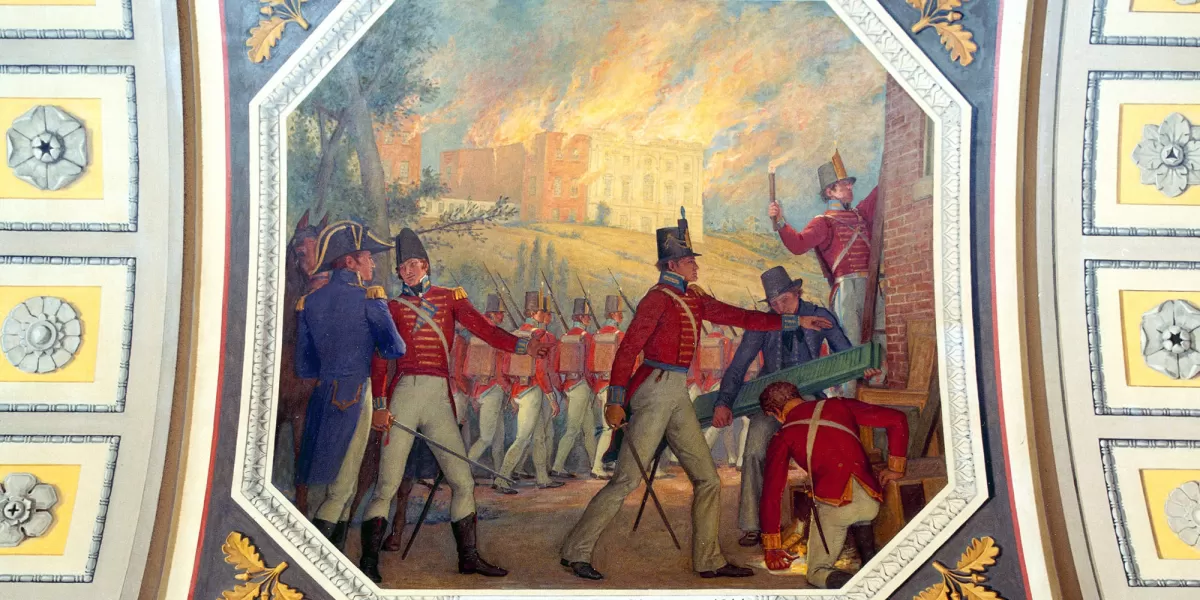
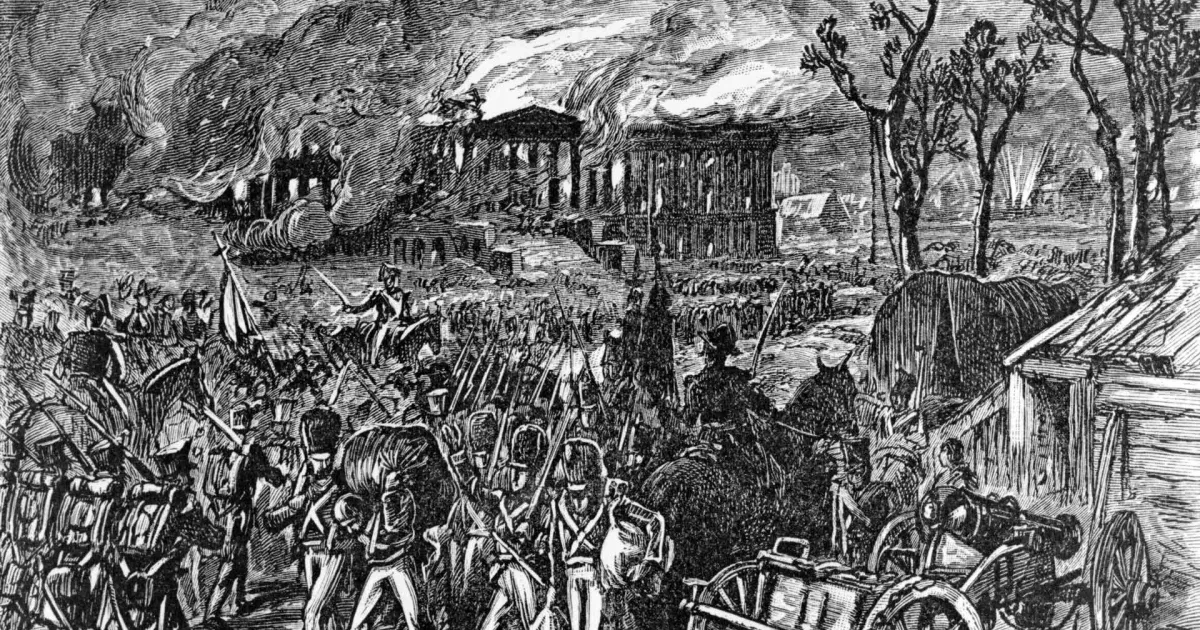
The War of 1812 arrived at the doorstep of the United States Capitol on August 24, 1814. Following the American defeat at the Battle of Bladensburg, a British force of approximately 4, 500 men led by Major General Robert Ross and Rear Admiral George Cockburn marched into Washington. The city was largely abandoned. The Capitol stood as an incomplete structure consisting of two wings connected by a temporary wooden walkway. It housed the Senate, the House of Representatives, the Supreme Court, and the Library of Congress. The British commanders viewed the building not as a legislative hall as a monument to a hostile democracy. Cockburn entered the House Chamber and reportedly mocked the democratic process. He climbed into the Speaker's chair and asked his troops if the harbor of "Yankee democracy" should be burned. The soldiers shouted their assent.
The destruction was methodical and chemically intense. Soldiers piled furniture, books, and papers in the center of the House and Senate chambers. They applied gunpowder paste to the heaps to act as an accelerant. In the House wing, the fire grew hot enough to melt the glass skylights. The molten glass rained down upon the floor. The heat calcined the Aquia Creek sandstone columns. This chemical reaction turned the stone into lime and caused it to disintegrate upon contact. The Supreme Court chamber in the basement of the Senate wing suffered severe damage as the wooden ceiling collapsed. The Library of Congress, then located in the Capitol, provided ample fuel. Approximately 3, 000 volumes burned. The fire destroyed the original Senate Chamber and reduced the interior of the House wing to a shell. Giuseppe Franzoni's life-size marble statue of Liberty, seated above the Speaker's rostrum, was consumed by the flames.
Nature intervened on August 25. A violent storm, possibly including a tornado, swept through the city. The torrential rain extinguished the fires compounded the structural damage. The winds tore roofs from buildings and knocked down chimneys. The Capitol was left a blackened skeleton. The British withdrew, the psychological blow to the young nation was severe. Congress reconvened in September 1814 at Blodgett's Hotel, the site of the Patent Office, which was the only major government building to survive the inferno. A serious debate ensued regarding the relocation of the federal capital. Northern representatives pushed to move the seat of government to Philadelphia or another established city. They argued that Washington was and in ruins. The motion to relocate failed by a narrow margin of nine votes.
Local investors intervened to secure the government's presence in Washington. A group of private citizens, including Daniel Carroll of Duddington, funded the construction of a temporary meeting place. This structure became known as the Old Brick Capitol. It stood on the site of the present-day Supreme Court building. Construction began on July 4, 1815, and workers completed the building in December at a cost of $25, 000. Congress met in this temporary facility from December 1815 until December 1819. The swift erection of the Old Brick Capitol ended the immediate threat of capital relocation. It allowed the federal government to focus on the complex task of reconstructing the main Capitol building.
President James Madison rehired Benjamin Henry Latrobe in April 1815 to oversee the reconstruction. Latrobe returned to find his previous work destroyed. He described the site as "a most magnificent ruin." The fire had revealed the vulnerabilities of the original construction methods. Latrobe determined that the new interior must be fireproof. He abandoned the use of timber for structural support. He designed a system of masonry vaults to support the floors and ceilings. This decision increased the weight of the building and required the strengthening of the internal walls. Latrobe used the opportunity to redesign the interior spaces. He enlarged the Senate Chamber and reconfigured the Hall of the House of Representatives into a semicircular shape inspired by ancient theaters.
Latrobe also sought to imprint a distinctly American iconography onto the neoclassical architecture. He rejected the strict adherence to Greek and Roman orders that characterized European public buildings. In the small rotunda of the Senate wing, he introduced columns featuring tobacco leaves and flowers. These "Tobacco Capitals" symbolized the economic importance of the crop to the nation. They joined the "Corn Cob Capitals" he had designed in 1809 for the Senate vestibule. The corn columns had survived the fire with minor damage. These architectural elements represented a departure from the traditional acanthus leaves of the Corinthian order. They served as a permanent stone record of American agriculture. Latrobe sourced new materials for the reconstruction. He used marble breccia from the upper Potomac Valley for the columns in the House and Senate chambers. The variegated stone added a richness to the interior that the original sandstone absence.
The reconstruction effort faced serious financial and administrative blocks. The cost of rebuilding exceeded initial estimates. By 1817, the project was plagued by delays and rising expenses. Latrobe clashed frequently with Samuel Lane, the Commissioner of Public Buildings. Lane was a bureaucratic appointee who prioritized cost-cutting over architectural integrity. The tension peaked over the appointment of Peter Lenox as the clerk of works. Lane insisted on Lenox even with Latrobe's objections. Latrobe viewed this as an infringement on his authority as the architect. The relationship between the two men beyond repair. Latrobe resigned his position on November 20, 1817. He left the Capitol with the wings largely reconstructed the central section still unbuilt.
President James Monroe appointed Charles Bulfinch as the new Architect of the Capitol on January 8, 1818. Bulfinch was a prominent Boston architect known for his Federal-style buildings. He inherited Latrobe's designs and the ongoing construction challenges. Bulfinch focused on completing the wings to allow Congress to return to the building. He adhered to Latrobe's plans for the interior chambers made modifications to the central section. Work proceeded rapidly under his supervision. The Senate and the House of Representatives were able to occupy their respective chambers in December 1819. The return of the legislature to the Capitol marked the end of the reconstruction phase following the British incineration. The building that emerged from the ashes was structurally stronger and architecturally more sophisticated than its predecessor.
| Metric | Data Point |
|---|---|
| Date of Burning | August 24, 1814 |
| British Troop Count | Approx. 4, 500 |
| Library of Congress Loss | ~3, 000 volumes |
| Old Brick Capitol Cost | $25, 000 (funded by private investors) |
| Old Brick Capitol Use | Dec 1815 , Dec 1819 |
| Reconstruction Architect | Benjamin Henry Latrobe (1815, 1817) |
| Successor Architect | Charles Bulfinch (1818, 1829) |
| New Material Source | Potomac Marble Breccia (Columns) |
| Reconstruction Funding | $500, 000 (initial borrowing authorized Feb 1815) |
The reconstruction period established precedents that would govern the Capitol's future expansion. The reliance on fireproof masonry became a standard safety requirement. The integration of American symbols into the decorative scheme set a stylistic course that future artists would follow. The political battles over funding and oversight between the Architect and the Commissioner foreshadowed the complex bureaucratic management of the Capitol complex. The "Old Brick Capitol" continued to serve the government even after Congress vacated it. It functioned as a prison during the Civil War before being demolished to make way for the Supreme Court. The scars of 1814 remained visible on of the exterior stones, a physical reminder of the fragility of the capital city during the early republic. The reconstructed Capitol stood not just as a place of lawmaking as a testament to the nation's refusal to abandon its seat of power.
Old Supreme Court Chamber and Federal Judicial Tenancy (1810, 1860)
In 1810, the Supreme Court of the United States descended into the ground floor of the Capitol's North Wing, occupying a chamber that would house the judiciary for half a century. This move marked the transition from temporary, borrowed committee rooms to a permanent, purpose-built cathedral of law. Architect Benjamin Henry Latrobe designed the space with high engineering ambition, constructing a vaulted ceiling that the conventions of the era. The room, measuring roughly 74 feet wide and 50 feet deep, sat directly beneath the Senate Chamber. To support the weight of the legislative floor above, Latrobe engineered a complex system of masonry vaults, a structural need that gave the room its distinctive, umbrella-like ceiling. The construction process itself demanded blood; in 1808, John Lenthall, the Clerk of the Works, died when the heavy vaulting collapsed prematurely, crushing him, a grim prologue to a chamber that would later deliver the nation's most fracturing legal opinion.
The physical environment of the Old Supreme Court Chamber exerted a heavy toll on its occupants. Situated on the basement level, the room suffered from perpetual dampness and poor ventilation. Contemporaries frequently described it as a "dark, low, subterranean apartment," where the air grew thick and the lighting remained dim even at midday. The only natural light entered through lunette windows on the eastern wall, frequently insufficient to pierce the gloom. To mitigate the darkness, the Court relied on oil lamps and later gas lighting, which consumed the limited oxygen and raised the temperature during crowded sessions. Justices and attorneys alike complained that the "mephitic" atmosphere ruined their health. Even with these harsh conditions, the chamber served as the forge for American constitutional law, hosting the golden age of oratory where Daniel Webster and Henry Clay argued before the Marshall and Taney Courts.
War interrupted the Court's tenure only four years after it arrived. On August 24, 1814, British troops stormed the Capitol, piling furniture in the Supreme Court Chamber and setting it ablaze. The fire gutted the interior, destroying the wooden furnishings and books, yet Latrobe's masonry vault survived the inferno, a testament to its structural integrity. "A most magnificent ruin," Latrobe called it, though he chose to and rebuild the vault to ensure safety during the reconstruction. The restoration, completed in 1819 under Charles Bulfinch, introduced a more refined aesthetic. The room featured a raised platform for the Justices, separated from the bar by a railing, enforcing a visual hierarchy between the bench and the attorneys. In the nearby vestibule, Latrobe installed columns with capitals modeled after ears of maize, the "Corn Cob" columns, an intentional departure from Greek and Roman orders to establish a distinctly American architectural language.
Chief Justice John Marshall presided over this basement courtroom during the era of federal consolidation. Between 1819 and 1835, the Marshall Court issued rulings that defined the scope of congressional power. In McCulloch v. Maryland (1819), arguably the most important decision in American judicial history, Marshall affirmed the supremacy of federal law over state action, denying Maryland the right to tax the Bank of the United States. The walls of the damp chamber echoed with Marshall's declaration that the power to tax involves the power to destroy. Five years later, in Gibbons v. Ogden (1824), the Court dismantled a New York steamboat monopoly, establishing Congress's sole authority to regulate interstate commerce. These decisions did not interpret law; they constructed the legal infrastructure of a unified national economy from within a room that visitors found resembling a dungeon.
The atmosphere shifted in 1836 with the appointment of Roger B. Taney as Chief Justice. The Taney Court moved away from Marshall's nationalism toward a jurisprudence centered on states' rights. The chamber's acoustics, known to be difficult, carried the weight of increasingly sectional arguments. In 1841, the Court heard United States v. The Amistad, where former President John Quincy Adams argued for the freedom of captive Africans who had mutinied aboard a Spanish ship. The Court ruled in favor of the Africans, a rare victory for abolitionist forces in a city built on slave labor. During this period, Taney ordered a clock from famous Massachusetts clockmaker Simon Willard. Installed in 1837, the clock faced the attorneys, and legend holds that Taney kept it set five minutes fast to ensure punctuality, a mechanical enforcement of discipline in a room frequently chaotic with spectators.
| Year | Case Name | Chief Justice | Impact on National Trajectory |
|---|---|---|---|
| 1819 | McCulloch v. Maryland | John Marshall | Established federal supremacy and implied powers; blocked state taxation of federal entities. |
| 1819 | Dartmouth College v. Woodward | John Marshall | Protected private contracts from state interference, securing the legal basis for corporate charters. |
| 1824 | Gibbons v. Ogden | John Marshall | Defined the Commerce Clause, granting Congress broad power to regulate interstate trade. |
| 1831 | Cherokee Nation v. Georgia | John Marshall | Defined Native American tribes as "domestic dependent nations," stripping them of foreign nation status. |
| 1841 | United States v. The Amistad | Roger B. Taney | Freed Africans who mutinied on a slave ship, ruling they were illegally kidnapped, not property. |
| 1857 | Dred Scott v. Sandford | Roger B. Taney | Ruled African Americans could not be citizens; invalidated the Missouri Compromise; accelerated the route to Civil War. |
The chamber's history culminated in a decision that shattered the nation. On March 6, 1857, an aging Chief Justice Taney read the majority opinion in Dred Scott v. Sandford. The room was packed; reporters and politicians crowded into the dim space, sensing the magnitude of the moment. Taney declared that African Americans, whether enslaved or free, were not citizens under the Constitution and therefore had no standing to sue in federal court. He went further, clear down the Missouri Compromise and ruling that Congress possessed no authority to prohibit slavery in the territories. The decision, intended to settle the slavery question forever, instead inflamed northern opinion and rendered the Civil War inevitable. The "subterranean apartment" had produced a ruling that would require blood to overturn.
By 1860, the Supreme Court had outgrown the cramped, unhealthy confines of the ground floor. With the Senate moving into the newly expanded wings of the Capitol, the Court ascended to the Old Senate Chamber on the principal floor. This move upward, from the basement to the light-filled room above, marked the end of the Court's formative era. The Old Supreme Court Chamber was repurposed as a law library, its vaulted ceiling continuing to shelter legal texts long after the Justices had departed. The space remains a paradox: an architectural jewel of the early republic that served as the incubator for both the consolidation of the American Union and the legal reasoning that nearly destroyed it.
Cast-Iron Dome Engineering and Statue of Freedom Assembly (1855, 1863)

The architectural transition from Charles Bulfinch's wooden dome to Thomas U. Walter's cast-iron colossus marked a definitive shift in American structural engineering. By 1855, the Bulfinch dome, dwarfed by the newly expanded House and Senate wings, presented a severe fire hazard and an aesthetic failure. Congress appropriated $100, 000 to replace it, initiating a project that would eventually consume nearly nine million pounds of iron. The undertaking fell under the volatile dual command of Architect of the Capitol Thomas U. Walter and Captain Montgomery C. Meigs of the Army Corps of Engineers. Their relationship into a bureaucratic war, with Meigs controlling the funds and logistics while Walter fought to retain design authority. Meigs, an engineer with a penchant for micromanagement, frequently altered Walter's specifications, leading to a bitter stalemate that only resolved when Meigs was reassigned in 1859.
The physical construction relied on the industrial might of the North. The contract for the ironwork went to Janes, Fowler, Kirtland & Co., a foundry located in the Bronx, New York. This firm executed the fabrication of 8, 909, 200 pounds of iron plates, ribs, and ornaments. To support this massive load upon the existing rotunda walls, Walter designed a double-shell system. A truss work of 36 curved iron ribs forms the skeleton, anchoring the structure while allowing the outer shell to expand and contract with temperature shifts. The inner shell, visible from the rotunda floor, stands lower to maintain proper interior proportions, while the outer shell rises to a height of 288 feet, maximizing exterior visibility. The iron arrived in Washington via schooner, where steam-powered derricks, fueled by the wood salvaged from the demolished Bulfinch dome, hoisted the segments into place.
Atop this engineering feat stands the Statue of Freedom, a bronze figure whose creation story embodies the central contradiction of the era. Sculptor Thomas Crawford, working in Rome, originally designed the figure wearing a pileus, the soft cap associated with manumission in Roman history. When Jefferson Davis, then serving as U. S. Secretary of War, reviewed the design in 1855, he issued a sharp rejection. Davis argued that the liberty cap was a symbol of freed slaves, a status he deemed inappropriate for a nation of people "born free." He insisted the cap be replaced. Crawford acquiesced, substituting a Roman helmet crested with eagle feathers. This revision, mandated by the future President of the Confederacy, erased an explicit reference to emancipation from the symbol of American liberty.
The statue's journey from Rome to Washington proved nearly as perilous as the political climate. Crawford died in 1857, leaving his widow to manage the shipment of the plaster model. The crates were loaded onto the bark Emily Taylor in 1858. The vessel sprang a serious leak and drifted into Gibraltar for repairs, then limped to Bermuda, where the cargo was condemned. After months of delay, the crates were transferred to a second ship and arrived in New York in December 1858, reaching Washington in March 1859. The plaster model, cast in five sections, required assembly before it could be used to create the bronze molds.
The casting process took place at the foundry of Clark Mills on Bladensburg Road, just outside the District of Columbia limits. Mills, a self-taught sculptor, relied heavily on enslaved labor. When the time came to separate the plaster sections of the Italian model to prepare them for casting, the Italian foreman hired for the task refused to proceed without a pay raise. He believed he possessed exclusive knowledge of the joint system. Philip Reid, an enslaved man owned by Clark Mills, stepped forward. Reid devised a method using a pulley and tackle to lift the top section by its iron ring, revealing the seams and allowing the model to be separated without damage. The Italian foreman was dismissed, and Reid assumed a primary role in the casting operation.
Federal payment records from the project provide a clear accounting of Reid's status. The government paid Clark Mills for the labor of his workforce. On Sundays, the only day Reid was not legally compelled to work for his master, the government paid Reid directly at a rate of $1. 25 per day. For the remaining six days of the week, his wages went to Mills. This arrangement continued until April 16, 1862, when President Abraham Lincoln signed the District of Columbia Compensated Emancipation Act. Reid gained his freedom mid-project. Clark Mills subsequently filed a petition seeking $1, 500 in compensation for the loss of his "property," describing Reid as "smart in mind" and a "good workman." The government paid Mills $350. 40 for Reid's manumission.
Construction on the dome proceeded against the backdrop of the Civil War. By 1861, funding absence and the threat of Confederate attack led to calls to halt the project. The contractor, Janes, Fowler, Kirtland & Co., continued work on credit, unpaid for extended periods. President Lincoln viewed the unfinished dome as a barometer of national resolve, remarking, "If people see the Capitol going on, it is a sign we intend the Union shall go on." The rising iron skeleton became a visible pledge that the federal government remained functional, even as Union troops quartered in the rotunda used the space as a makeshift hospital and barracks.
The final assembly of the Statue of Freedom occurred in late 1863. The bronze sections, weighing a total of approximately 15, 000 pounds, were hoisted to the top of the lantern. The final piece, the head and shoulders, was lifted on December 2, 1863. Philip Reid, a free man, assisted in the final installation. At 12: 00 PM, the head was secured, and a flag unfurled overhead. A battery of artillery on Capitol Hill fired a 35-gun salute, answered by guns from the twelve forts surrounding Washington. The sound of the cannons signaled not only the completion of the dome the irony of a freedom statue, censored by a Confederate leader and cast by an enslaved man, watching over a city at war over the definition of liberty.
| Metric | Value |
|---|---|
| Total Weight of Iron (Dome) | 8, 909, 200 lbs |
| Statue Weight | 14, 985 lbs |
| Statue Height | 19 feet, 6 inches |
| Dome Height (Base to Torch) | 217 feet |
| Total Height (East Front to Torch) | 288 feet |
| Dome Cost (approx.) | $1, 047, 291 |
| Statue Sculptor | Thomas Crawford |
| Dome Architect | Thomas U. Walter |
| Iron Contractor | Janes, Fowler, Kirtland & Co. |
| Statue Caster (Foundry Owner) | Clark Mills |
| Foreman of Casting | Philip Reid |
The technical success of the dome relied on the precise calibration of its iron components. The skirt of the dome rests upon a peristyle of 36 columns, which are cantilevered from the masonry walls of the rotunda. This design distributes the crushing weight of the cast iron outward, preventing the collapse of the sandstone walls beneath. The 36 ribs of the dome align with these columns, creating a continuous vertical thrust line. To manage thermal expansion, which could cause the iron to buckle or crack the masonry, Walter used a system where the iron shell "floats" to a degree, allowing the metal to move independently of the stone base. This foresight prevented structural failure during the extreme temperature fluctuations of Washington summers and winters.
The completion of the dome in 1866, three years after the statue's placement, marked the end of the major exterior construction. Constantino Brumidi continued his work on the interior fresco, The Apotheosis of Washington, suspended just the lantern. The structure stood as a completed entity, a fireproof iron shell replacing the rotting wood of the past. The cost, exceeding one million dollars, drew criticism, yet the result was a permanent skyline fixture that survived the war that threatened to dissolve the government it housed.
National Statuary Hall Weight Load and Collection Logistics
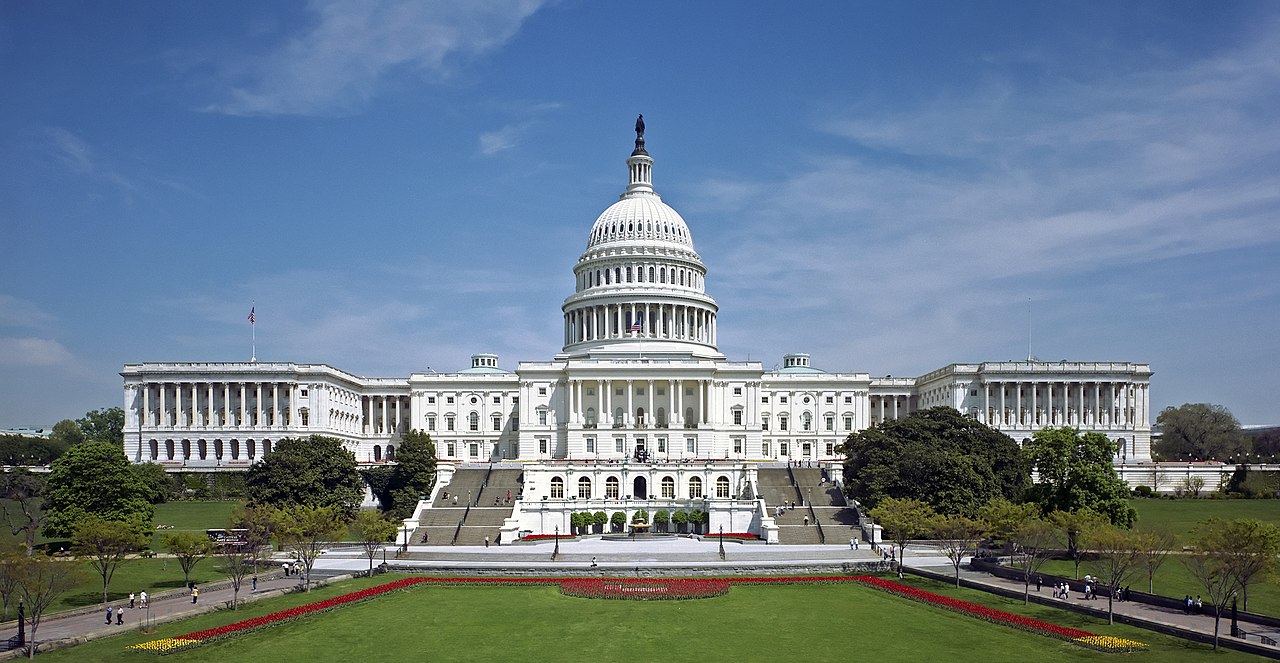
The chamber's original design by Benjamin Henry Latrobe and Charles Bulfinch, completed in 1819 after the British arson of 1814, featured a smooth, half-domed ceiling. This architectural choice created a "whispering gallery" effect so severe that it rendered legislative debate nearly impossible. Representatives frequently could not hear a colleague speaking from across the room, yet could hear private whispers from distant corners. After decades of failed acoustic experiments, including hanging heavy draperies and reversing the seating arrangement, the House abandoned the hall in 1857 for the new south wing. The vacated space, then a "pedestal waiting for a monument," was repurposed in 1864 when Representative Justin Morrill of Vermont sponsored legislation to establish a national collection. The act invited each state to contribute two statues of deceased citizens "illustrious for their historic renown."
By 1933, the collection had grown to 65 statues, arranged in concentric rings and sometimes standing three deep. The visual clutter was significant, the structural danger was acute. The floor, supported by early 19th-century brick arches, was never designed to bear the concentrated dead load of dozens of marble and bronze figures, which can weigh several tons each. Engineers determined that the total weight of the collection exceeded the floor's safe load-bearing capacity, creating a genuine risk of catastrophic failure. In response, Congress passed House Concurrent Resolution No. 47 on February 24, 1933. This measure capped the number of statues in the Hall itself, originally limiting it to one per state, and authorized the Architect of the Capitol (AOC) to redistribute the overflow to other areas, such as the Hall of Columns and the Rotunda.
Modern logistics for the collection are governed by strict engineering metrics to prevent a recurrence of the 1933 emergency. Current guidelines dictate that a bronze statue and its pedestal must not exceed a combined weight of 5, 000 pounds. Marble statues, which are significantly denser, are permitted a maximum combined weight of 10, 000 pounds. Before any new installation, the AOC's structural engineers must verify that the specific floor location can support the load. As of 2026, only 38 statues remain in the National Statuary Hall proper. The remainder of the 100-statue collection (two per state) is dispersed throughout the Capitol Visitor Center (CVC), the Crypt, and the corridors of the House and Senate wings.
The mechanics of the collection changed fundamentally in 2000. Prior to this, a state's donation was essentially permanent. Legislation passed that year allowed states to request the replacement of a statue that had been on display for at least 10 years. This legal method triggered a wave of modernization and political re-evaluation that accelerated in the 2020s. The logistics of these swaps involve complex rigging operations, frequently requiring the construction of custom gantries to lift multi-ton stone figures without damaging the historic fabric of the building.
Recent years have seen high-profile substitutions reflecting shifting historical narratives. In May 2024, North Carolina replaced the statue of Charles Aycock, a governor associated with white supremacy, with a bronze likeness of evangelist Billy Graham. That same month, Arkansas installed a statue of civil rights leader Daisy Bates, replacing the marble figure of 19th-century lawyer Uriah Rose. In September 2024, Arkansas completed its update by unveiling a bronze statue of musician Johnny Cash in the Capitol Visitor Center's Emancipation Hall, replacing the statue of Senator James P. Clarke. The Cash statue, sculpted by Kevin Kresse, depicts the "Man in Black" with a guitar slung over his back and a Bible in hand, marking the time a professional musician has been inducted into the collection.
The removal of Confederate figures has been a primary driver of recent logistical activity. Virginia, which had contributed a statue of Robert E. Lee in 1909, removed the figure in 2020. Its replacement, a statue of civil rights activist Barbara Johns, was scheduled for unveiling on December 16, 2025. Johns, who led a student walkout in 1951 to protest unequal school facilities, represents a clear departure from the "Lost Cause" iconography that previously dominated the state's contribution. Similarly, Florida replaced Confederate General Edmund Kirby Smith with educator Mary McLeod Bethune in 2022, and Nebraska replaced William Jennings Bryan with Ponca Chief Standing Bear in 2019.
| State | Removed Statue | New Statue | Installation Year |
|---|---|---|---|
| Nebraska | William Jennings Bryan | Chief Standing Bear | 2019 |
| Virginia | Robert E. Lee | Barbara Johns | 2025 |
| Florida | Edmund Kirby Smith | Mary McLeod Bethune | 2022 |
| North Carolina | Charles Aycock | Billy Graham | 2024 |
| Arkansas | Uriah Rose | Daisy Bates | 2024 |
| Arkansas | James P. Clarke | Johnny Cash | 2024 |
The physical arrangement of the statues is not static. While the 1933 resolution mandated dispersal for safety, the aesthetic arrangement is periodically reviewed by the Joint Committee on the Library. The 38 statues currently residing in the Hall are placed between the columns of variegated Breccia marble, standing on the black and white marble tile floor. This flooring, installed during the 1864 renovation to replace the original wood, hides the hypocaust heating system that once attempted, and failed, to warm the cavernous space. The room's history as a legislative failure paved the way for its success as a national gallery, only through the strict enforcement of weight limits that acknowledge the building's finite structural endurance.
1954 House Chamber Shooting and 1998 Officer Homicides
| Feature | March 1, 1954 Incident | July 24, 1998 Incident |
|---|---|---|
| Perpetrators | 4 Puerto Rican Nationalists (Group) | Russell Eugene Weston Jr. (Lone Actor) |
| Primary Weaponry | 9mm Luger P08, Walther P38 (Semi-auto) | . 38 Caliber Smith & Wesson (Revolver) |
| Location | House Chamber (Ladies' Gallery) | Document Door (East Front) & Whip's Office |
| Casualties | 5 Representatives Wounded (0 Dead) | 2 USCP Officers Killed (Chestnut, Gibson) |
| Security Outcome | Gallery glass installation, bag checks | Capitol Visitor Center construction accelerated |
The deaths of Officers Chestnut and Gibson marked a turning point in Capitol security architecture. For years, architects and security officials had proposed a subterranean visitor center to screen tourists away from the historic building. The 1998 murders provided the political to fund and execute this massive infrastructure project. The "Jacob Joseph Chestnut, John Michael Gibson United States Capitol Visitor Center Act of 1998" authorized the construction. This facility, which opened in 2008, moved the security perimeter hundreds of feet away from the Capitol dome. It required the excavation of 65, 000 truckloads of soil from the East Front. The Document Door, where Weston entered, was renamed the Chestnut-Gibson Memorial Door. The tragedy demonstrated that the Capitol's greatest strength, its openness to the people, was also its most serious security liability. The sacrifice of the two officers remains a central part of the USCP's history, commemorated annually, and their actions prevented a gunman from reaching legislative leadership. The 1998 shooting ended the era of the Capitol as a walk-in office building and began its transformation into a hardened, albeit accessible,.
Capitol Visitor Center Excavation and Fiscal Overruns (2000, 2008)
The catalyst for the most extensive expansion of the United States Capitol in its history arrived not through architectural ambition through violence. On July 24, 1998, a gunman entered the Document Door on the East Front and opened fire, killing United States Capitol Police officers Jacob Chestnut and John Gibson. This breach of the "People's House" shattered the illusion that open access could coexist with modern threat levels without a fortified buffer. While a visitor center had been proposed as early as the mid-1970s to manage the increasing tourist foot traffic, the 1998 murders transformed the project from a convenience into a security imperative. Congress moved swiftly to authorize the construction of a subterranean facility that would serve as the single secure entry point for the millions of annual visitors. The ceremonial groundbreaking took place on June 20, 2000, initiating a project that would soon become synonymous with fiscal ballooning and engineering complexity.
The of the excavation was for a federal building in Washington. Engineers tasked the construction teams with digging a pit large enough to swallow the entire Capitol dome three times over. The project footprint covered 193, 000 square feet on the East Front, requiring the removal of approximately 650, 000 cubic yards of earth. This volume translated to roughly 65, 000 truckloads of soil hauled away from the historic center of American government. The depth of the excavation reached nearly 70 feet in certain sectors, placing the bottom of the pit dangerously close to the spread footings of the historic Capitol building. To prevent the 19th-century iron dome from shifting or cracking, workers installed a massive slurry diaphragm wall and used hundreds of tiebacks to anchor the earth. Monitoring equipment measured movement to the millimeter, as any settling could have caused catastrophic structural failure to the Rotunda above.
The original timeline and budget, established around 1999, estimated a cost of $265 million with a completion date targeting the 2005 presidential inauguration. Yet the geopolitical reality shifted drastically on September 11, 2001. The terrorist attacks on New York and Washington, followed closely by the anthrax letters sent to Senate offices in October 2001, forced a radical re-evaluation of the Capitol Visitor Center (CVC). The mission expanded from visitor education to continuity of government. Security officials demanded the inclusion of advanced air filtration systems capable of scrubbing biological and chemical agents, hardened tunnels connecting to the Library of Congress and Senate office buildings, and reinforced structural elements. This "scope creep" fundamentally altered the engineering requirements midway through the dig.
Fiscal oversight reports from the Government Accountability Office (GAO) began to paint a grim picture of the project's financial health by 2003. The budget estimates climbed relentlessly, jumping from the initial $265 million to $360 million, then breaching the half-billion-dollar mark. Architect of the Capitol Alan Hantman faced withering questioning from congressional appropriations committees as the completion date slipped from 2005 to 2006, and to late 2008. Factors beyond security upgrades also contributed to the. The project encountered record-breaking rainfall in 2003 which turned the massive open pit into a mud bog, delaying concrete pours for months. Workers also discovered an undocumented century-old well and hazardous asbestos in the existing foundation tunnels, necessitating costly remediation. By the time the dust settled, the final price tag had surged to approximately $621 million, more than double the original appropriation.
The architectural intent of the CVC was to remain invisible from the exterior, preserving the historic sightlines of the dome and the designed by Frederick Law Olmsted in 1874. The roof of the facility serves as the paved East Front Plaza, punctuated by large skylights that filter natural light into the subterranean chambers. Inside, the facility spans 580, 000 square feet, approximately three-quarters the size of the Capitol building itself. The interior design relies heavily on sandstone, the same material used in the original Capitol construction, to create a visual continuity between the new and old structures. Workers installed nearly 200, 000 square feet of interior stone cladding. The centerpiece of the facility is a vast gathering space originally in the blueprints as the "Great Hall."
A significant political struggle erupted over the naming of this central atrium. As construction neared completion, a coalition of lawmakers led by Representative Jesse Jackson Jr. and Representative Zach Wamp argued that the term "Great Hall" was generic and failed to acknowledge the historical context of the site. They pushed for the space to be named "Emancipation Hall" to honor the enslaved African Americans who quarried the stone, cut the timber, and baked the bricks for the original Capitol in the 1790s. The proposal faced initial resistance from traditionalists who felt the name was political, yet the historical record of slave labor at the Capitol was irrefutable. Congress passed the legislation, and President George W. Bush signed it into law in January 2008. This decision marked the time a major space within the Capitol complex was explicitly named to recognize the contributions of enslaved laborers.
Critics of the project frequently derided the CVC as a "congressional bunker" rather than a true visitor center. They pointed to the fact that of the 580, 000 square feet was reserved not for tourists, for new congressional meeting rooms, a 450-seat auditorium for the House, and secure staging areas. The facility provided the legislature with a modern, blast-resistant expansion hidden in plain sight. The layout forces all public visitors to enter through the underground tunnels, subjecting them to airport-style security screening far removed from the actual legislative chambers. This design achieved the primary goal of the post-1998 security mandate: isolating the public threat from the legislative function.
The Capitol Visitor Center opened its doors on December 2, 2008, a date chosen to coincide with the 145th anniversary of the placement of the Statue of Freedom atop the Capitol Dome. The finished structure included an exhibition gallery housing historical artifacts, two orientation theaters, and a 530-seat cafeteria, the largest dining facility in the complex. Even with the controversies regarding its cost and the delays that pushed it years past its deadline, the CVC fundamentally altered the logistics of the Capitol. It ended the era where citizens could walk freely up the East Front steps and enter the Rotunda, replacing that open tradition with a managed, secure, and curated underground experience. The project stands as a physical manifestation of the shift in American governance from the open access of the 19th century to the fortified security state of the 21st.
Dome Restoration and Rotunda Fresco Conservation Projects (2014, 2016)
By 2013, the cast-iron dome of the United States Capitol had entered a state of serious structural distress. Water infiltration had plagued the edifice for years, causing more than 1, 000 cracks to fracture the iron plates that Thomas U. Walter designed in the 1850s. Rainwater and melted snow seeped through pinholes in the Statue of Freedom and open joints in the tholos balustrade, rusting the ironwork and damaging the protective paint coatings. Inside the Rotunda, water stains began to mar the coffered ceiling, signaling that the envelope of the legislative seat had failed. The Architect of the Capitol (AOC), Stephen T. Ayers, identified the situation as a matter of urgency, noting that pieces of the iron ornaments, weighing significantly, were at risk of detaching and falling to the plaza.
In November 2013, the AOC awarded a contract to a joint venture between Turner Construction and Smoot Construction to execute a detailed rehabilitation. The project, budgeted at approximately $60 million, aimed to repair the exterior shell and restore the interior rotunda before the 2017 presidential inauguration. This undertaking marked the complete restoration of the dome since 1960. Unlike previous cosmetic fixes, this operation required the total removal of lead paint and the structural reintegration of the iron plates. Work began in early 2014, with crews erecting a massive scaffold system that would soon encase the dome in a white, cage-like structure.
The scaffolding itself was an engineering feat necessary to access every square inch of the dome's surface. Workers installed 1. 1 million pounds of scaffolding, comprised of 52 miles of pipe and two miles of decking. To ensure the Rotunda remained open to the public and Congress, the team designed a "donut" shaped tension-fabric system inside the dome. This catch-netting protected visitors from falling debris while leaving the center open, allowing the Apotheosis of Washington fresco to remain visible from the floor 180 feet. This configuration allowed legislative business and tourism to continue without interruption, even as heavy industrial work proceeded overhead.
Repairing the cast iron presented a specific metallurgical challenge. Cast iron is brittle and does not respond well to the high heat of standard welding, which can cause further cracking due to thermal expansion and contraction. To solve this, the restoration team used a cold-repair technique known as "Lock-n-Stitch." Workers drilled rows of holes along the length of each crack, then inserted metal pins that overlapped to create a continuous, water-tight seal. They then installed steel locks perpendicular to the cracks to pull the iron edges together. This labor-intensive method required hand-repairing 12, 800 inches of cracks, ensuring the structural integrity of the dome without compromising the original material.
The removal of hazardous materials constituted a major phase of the operation. The dome bore up to 14 of paint, containing lead from the original 19th-century applications. Crews worked inside negative-pressure containment areas to blast away the old coatings, collecting the toxic debris for safe disposal. Once stripped to the bare metal, the iron received a new three-coat paint system designed to resist corrosion. The final topcoat used 1, 215 gallons of "Dome White," a color specifically formulated to match the limestone of the Capitol's lower exterior. The team also removed and recast damaged ornaments, including acorns and grape clusters, at a foundry in Utah before reinstalling them.
Inside the Rotunda, conservators turned their attention to the artwork. While the exterior work stopped water from entering, the interior surfaces required cleaning and stabilization. The Apotheosis of Washington, painted by Constantino Brumidi in 1865, received a detailed conservation assessment. Conservators also cleaned the Frieze of American History, a panoramic grisaille fresco that circles the base of the dome interior. Years of grime and dust were removed, revealing details in Brumidi's work that had been obscured for decades. The project also included the installation of new LED lighting to illuminate the rotunda more and.
The restoration concluded in November 2016, finishing on time and under budget. Architect of the Capitol Stephen Ayers announced the completion just weeks before the inauguration of Donald Trump, fulfilling the mandate to have the "Nation's Stage" ready for the transition of power. The removal of the scaffolding revealed a gleaming, water-tight structure, securing the physical safety of the Capitol for the generation. The project stands as a primary example of modern engineering adapting to preserve 19th-century craftsmanship.
| Metric | Value |
|---|---|
| Total Project Cost | ~$60 Million (Completed Under Budget) |
| Scaffolding Weight | 1. 1 Million Pounds |
| Scaffolding Pipe Length | 52 Miles |
| Cracks Repaired | ~1, 300 (12, 800 linear inches) |
| Paint Removed | 10, 14 (Lead Abatement) |
| Paint Applied | 1, 215 Gallons ("Dome White") |
| Ornaments Restored/Recast | Includes 72 Acorns and 36 Rosettes |
| Completion Date | November 15, 2016 |
January 6 Complex Breach and Physical Damage Assessment (2021)
The physical violation of the United States Capitol on January 6, 2021, exposed severe vulnerabilities in the complex's perimeter security, specifically regarding the reinforcement of ground-level apertures. While the Architect of the Capitol (AOC) had executed a window upgrade program between 2017 and 2019 to install bomb-resistant glass, planners omitted approximately a dozen ground-floor windows and glass-paned doors on the West Front. Engineers deemed these entry points low-risk or historically sensitive, a calculation that proved disastrous when the mob focused its kinetic energy on these exact weak points. At 2: 13 p. m., a rioter used a stolen police shield to shatter a window adjacent to the Senate Wing Door, creating the breach point through which the crowd poured into the legislative chambers.
Architect of the Capitol J. Brett Blanton later testified that the initial assessment of damages to the building and grounds exceeded $30 million, though this figure conflated immediate physical repairs with the urgent need for temporary security fencing and National Guard support. A more granular forensic accounting, filed in federal court in April 2022, the direct property damage at exactly $2, 734, 783. 14. This sum covered the replacement of shattered glazing, the repair of splintered historic millwork, and the specialized chemical remediation required to strip tear gas and pepper spray residue from the porous sandstone and marble surfaces of the Rotunda and Statuary Hall.
The assault inflicted specific, measurable harm on the Capitol's curated collection of fine art. Curators identified that the marble bust of President Zachary Taylor, sculpted in 1883, was smeared with a substance confirmed to be human blood. The bust of Chippewa statesman Be shekee (Buffalo) suffered damage from chemical agents, as did the statue of Thomas Jefferson and portraits of James Madison and John Quincy Adams. Conservators noted that the corrosive particulate matter from fire extinguishers and riot control agents settled into the crevices of these artworks, requiring microscopic cleaning to prevent long-term degradation. While the monumental Trumbull paintings in the Rotunda, such as The Declaration of Independence, escaped direct vandalism, they were exposed to an environment thick with caustic dust and humidity fluctuations caused by the breach.
Beyond the static arts, the human toll on the Capitol Police constituted a significant degradation of the force's operational capacity. The union representing the officers reported that approximately 140 members of the Capitol Police and Metropolitan Police Department sustained documented physical injuries. These included cracked ribs, smashed spinal discs, and the loss of an eye. One officer was stabbed with a metal fence stake, while dozens of others suffered concussions and chemical burns. This depletion of manpower forced the department to operate at a deficit for months, further the security apparatus of the legislative branch.
The financial resolution of these damages entered a chaotic phase between 2021 and 2026. Federal prosecutors initially sought restitution from convicted defendants, securing orders for payments ranging from $500 for misdemeanors to $2, 000 for felonies. By early 2025, the government had collected hundreds of thousands of dollars intended for the Architect of the Capitol's revolving fund. Yet, the legal environment shifted radically following the presidential pardons issued in January 2025. In August 2025, U. S. District Judge John Bates ordered the Department of Justice to refund $2, 270 in restitution to a pardoned defendant, establishing a precedent that the vacatur of convictions necessitated the return of financial penalties. This legal turn transferred the cost of the physical damage back to the American taxpayer.
| Category | Specific Impact / Metric |
|---|---|
| Direct Property Damage | $2, 734, 783. 14 (Finalized April 2022 estimate for repairs) |
| Security & Cleanup Costs | $30, 000, 000+ (Initial appropriation for fencing, hazardous waste removal, and personnel) |
| Structural Breaches | Senate Wing Door, House Wing Door, multiple unreinforced West Front windows |
| Artworks Damaged | Zachary Taylor bust (blood), Be shekee bust (chemicals), Thomas Jefferson statue (residue), Olmsted light fixtures (destroyed) |
| Officer Casualties | 140+ documented injuries (concussions, fractures, chemical burns, loss of eye) |
| Restitution Status (2026) | Court-ordered repayments largely refunded following 2025 executive pardons |
The cleanup operations required the treatment of the Capitol as a hazardous materials site. Crews used specialized HEPA vacuums and neutralizers to remove the chemical irritants that had bonded with the building's historic fabric. The West Front, the site of the inauguration stands, required extensive scrubbing to remove graffiti and debris before the transition of power could proceed. By 2026, while the visible scars on the stone had been erased, the security posture of the Capitol had been permanently altered, with the installation of retractable fencing systems and reinforced glass laminates designed to withstand the very kinetic forces that breached the perimeter in 2021.
Security Perimeter Hardening and Surveillance Upgrades (2021, 2026)
USCP Threat Assessment Cases (2017, 2025)
| Year | Total Cases Investigated | Year-over-Year Change |
|---|---|---|
| 2017 | 3, 939 | - |
| 2018 | 5, 206 | +32. 1% |
| 2019 | 6, 955 | +33. 6% |
| 2020 | 8, 613 | +23. 8% |
| 2021 | 9, 625 | +11. 7% |
| 2022 | 7, 501 | -22. 1% |
| 2023 | 8, 008 | +6. 7% |
| 2024 | 9, 474 | +18. 3% |
| 2025 | 14, 938 | +57. 6% |
Beyond physical blocks, the surveillance grid underwent a total overhaul. The supplemental funding authorized the installation of high-resolution cameras with expanded coverage of the Capitol grounds and interior tunnels. By 2024, the United States Capitol Police (USCP) had launched the Protective Intelligence Operations Center (PIOC), a 24/7 command hub designed to centralize threat monitoring. This facility integrated data from social media scraping, local law enforcement feeds, and the upgraded camera network to identify threats before they reached the perimeter. The shift from reactive policing to predictive intelligence became the agency's primary doctrine under Chief Tom Manger, and later, Chief Michael Sullivan. The data reveals a disturbing trajectory in the threat environment. As shown in the table above, investigations into threats against Members of Congress and the Capitol complex surged to 14, 938 cases in 2025, a record high that nearly doubled the volume seen in 2022. This explosion in hostile communications and stalking behaviors forced the USCP to expand its reach far beyond Washington, D. C. Recognizing that threats frequently originated in members' home districts, the agency aggressively pursued "formal agreements" with local police departments. In 2025 alone, the number of these partnerships tripled, growing from approximately 115 to over 350 agencies. This network allowed the USCP to deputize local officers to provide security for lawmakers outside the capital, extending the Capitol's security perimeter to cover the entire nation. The Architect of the Capitol also focused on the "invisible" infrastructure of security. The 2021 supplemental bill allocated funds to upgrade the secure vestibules at the North and South entrances. These checkpoints, previously bottlenecks that left officers and visitors exposed, were redesigned to allow for faster screening within ballistic-rated enclosures. Simultaneously, the AOC addressed the "hodgepodge" fire suppression systems that J. Brett Blanton, the Architect at the time, had identified as a catastrophic liability during the riots. The fear was that an arsonist could have easily ignited the historic timber framing of the older sections, turning the siege into a mass casualty fire event. Upgrades to these life-safety systems proceeded alongside the security hardening, treating fire and intrusion as dual existential threats. Technological in drone detection also reshaped the airspace above the dome. Following several incursions by unauthorized unmanned aerial systems (UAS), the Capitol Police deployed new electronic countermeasures capable of jamming or seizing control of commercial drones entering the restricted flight zone. This of defense, largely invisible to the public on the ground, addressed the growing risk of aerial surveillance or payload delivery by hostile actors. The integration of these systems required close coordination with the FAA and the Secret Service, further binding the Capitol's security apparatus into the broader federal defense network. By early 2026, the Capitol had evolved into a hybrid. The razor wire of 2021 was gone, replaced by a sophisticated, defense system that relied as much on data algorithms and blast-resistant glazing as it did on uniformed officers. The physical scars of the insurrection had been repaired, the broken glass replaced, the doors reinforced, the operational reality had shifted permanently. The "People's House" operated behind a veil of high-tech surveillance and hardened architecture, a necessary adaptation to a world where the threat of political violence had become a chronic condition of American governance. The completion of all 103 recommendations from the Inspector General's post-January 6 report marked the end of the remedial phase and the beginning of a new era of permanent, elevated vigilance.
Lincoln Catafalque Protocols and Rotunda Lying in State
| Name | Role | Dates | Category | Notes |
|---|---|---|---|---|
| Henry Clay | Senator / Sec. of State | July 1, 1852 | Lying in State | person to lie in state in Rotunda. Pre-dates Lincoln Catafalque. |
| Abraham Lincoln | President | April 19, 21, 1865 | Lying in State | use of the Lincoln Catafalque. |
| Unknown Soldier | WWI Casualty | Nov 9, 11, 1921 | Lying in State | Represented all unidentified WWI dead. |
| John F. Kennedy | President | Nov 24, 25, 1963 | Lying in State | Catafalque base modified for stability. |
| Rosa Parks | Civil Rights Activist | Oct 30, 31, 2005 | Lying in Honor | woman to lie in honor. |
| Billy Graham | Religious Leader | Feb 28, Mar 1, 2018 | Lying in Honor | Fourth private citizen to lie in honor. |
| Ruth Bader Ginsburg | Supreme Court Justice | Sept 25, 2020 | Lying in State | Held in Statuary Hall due to COVID-19. |
| William Evans | Capitol Police Officer | April 13, 2021 | Lying in Honor | "Honor" recipient to use Lincoln Catafalque. |
| Ralph Puckett Jr. | Korean War Veteran | April 29, 2024 | Lying in Honor | Last surviving Korean War Medal of Honor recipient. |
| Jimmy Carter | President | Jan 7, 9, 2025 | Lying in State | Died Dec 29, 2024. Longest-lived President. |
The visual impact of the catafalque in the Rotunda relies on the clear contrast between the black cloth and the white sandstone walls. The lighting is frequently dimmed. The acoustics of the dome amplify the footsteps of the guard. This sensory environment is designed to provoke awe. It serves as a reminder of the continuity of the government. The death of a leader does not halt the of the state. The catafalque acts as the physical link between the assassinated Lincoln and the contemporary deceased. It forces a visual association between every modern leader and the preservation of the Union in 1865. Access to the Rotunda during these events is controlled by the Capitol Police. The public frequently waits in lines stretching for miles. The line for President Reagan in 2004 extended past the National Mall. The line for President Ford in 2006 was similarly extensive. The logistics of moving thousands of people through the security checkpoints require the mobilization of federal law enforcement. The Architect of the Capitol staff works continuously to clean the floors and maintain the dignity of the space while the crowds pass. The carpet is frequently protected by runners. The statues are sometimes cordoned off. The focus remains entirely on the center of the room. The refusal to grant the Rotunda to Jesse Jackson in 2026 highlights the political nature of the space. The Rotunda is not a neutral ground. It is a controlled stage. The Speaker of the House and the Senate Majority Leader hold the keys. Their consensus determines who enters the pantheon of American memory. The denial was based on a strict interpretation of "official" service. Yet the definition of service has expanded and contracted over time. The inclusion of the Unknown Soldiers expanded it to the anonymous rank and file. The inclusion of Rosa Parks expanded it to the moral leadership of the citizenry. The exclusion of Jackson suggests a chance retraction or a return to a more rigid standard in the mid-2020s. The Lincoln Catafalque remains the silent witness to these shifts. It is a utilitarian object made of cheap wood. It was never intended to last beyond 1865. Its survival is an accident of history that became a need of protocol. It connects the raw grief of the Civil War to the televised state funerals of the modern era. It is the only object in the Capitol that is regularly used for the same purpose for which it was built in the 19th century. Every other desk, chair, and chamber has evolved. The catafalque remains a pine platform draped in black. It waits in the dark of the Visitor Center for the concurrent resolution.
Congressional Subway System and Tunnel Network Infrastructure
| Era | Line | Technology | Status |
|---|---|---|---|
| 1909, 1912 | Russell (Senate) | Studebaker Electric Automobiles | Decommissioned |
| 1912, 1961 | Russell (Senate) | Overhead Monorail (Wicker Coaches) | Decommissioned |
| 1960, 1993 | Dirksen (Senate) | Operator-Controlled Monorail | Replaced |
| 1965, Present | Rayburn (House) | Manned Electric Rail | Active |
| 1993, Present | Hart/Dirksen (Senate) | Automated Guideway Transit (Driverless) | Active |
The modern Senate subway system, completed in 1993 to serve the Hart and Dirksen buildings, represents the most advanced node in the network. This $18 million project introduced driverless, automated trains similar to airport people movers. These vehicles run on a "pinched loop" track, capable of moving vertically along the tunnel walls to switch directions. The system was designed to reduce wait times to less than 90 seconds, a serious metric during roll-call votes when Senators must move from their offices to the floor immediately. As of 2026, this system remains the primary transit artery for the Senate side, though the older Russell line still operates a manned, open-air train that retains a vintage aesthetic even with modern mechanical upgrades. Parallel to the transit lines runs a more dangerous and industrial network: the utility tunnels connected to the Capitol Power Plant. Established in 1910, the Power Plant (located several blocks south of the Capitol) distributes steam and chilled water to the complex. The tunnels housing these pipes are hostile environments. In 2006, the Office of Compliance filed complaints regarding the condition of these utility shafts, citing falling concrete, the presence of asbestos, and ambient temperatures exceeding 100 degrees Fahrenheit. These tunnels are distinct from the polished subway corridors; they are the gritty, hazardous guts of the legislative branch. Workers in these confined spaces maintain the thermal regulation of the Capitol, a task that requires constant vigilance against the decaying infrastructure of the early 20th century. Security following the January 6, 2021, breach fundamentally altered the operational doctrine of the tunnel network. Prior to 2021, the tunnels were viewed primarily as convenience corridors. In the post-2021 era, they are as primary evacuation routes. The tunnels allowed for the secure movement of Senators and staff during the riot, proving their value as a survival method. By 2026, the security posture within these subterranean passages includes reinforced blast doors, upgraded surveillance arrays capable of facial recognition, and independent air filtration systems designed to counter chemical or biological threats. The "open" nature of the tunnels, once a quirky feature of Capitol Hill life where tourists could catch a glimpse of a Senator, has been curtailed in favor of a hardened defensive perimeter. The maintenance of this infrastructure presents a continuous fiscal challenge. The Architect of the Capitol requests annual appropriations specifically for the "State of Good Repair" of these assets. The Rayburn line, over 60 years old, requires frequent mechanical overhauls to ensure the manned trains do not fail during serious legislative windows. The concrete liners of the older tunnels, particularly those dating back to the Russell construction, demand constant monitoring for water infiltration and structural fatigue. The Cannon Tunnel, while absence a train, serves as a important pedestrian artery and a cultural gallery. It hosts the Congressional Art Competition, displaying winning pieces from high school students across the nation. This usage masks the tunnel's strategic function: it is a hardened underground link that allows the House to function even if the surface streets are compromised. The dual nature of the tunnels, as galleries and bunkers, transit systems and escape routes, defines the modern reality of the Capitol complex. As the United States moves through 2026, the subway system stands as a testament to the tension between tradition and need. The Senate still rides the open-air cars to the Russell building, a nod to the 1909 origins, while the automated trains of the Hart line represent the computerized efficiency of the modern state. Beneath them all, the steam tunnels hiss with the pressure of heating the massive legislative halls, a reminder that the seat of government relies on a dirty, dangerous, and hidden industrial foundation to function. The network is a physical manifestation of the legislative branch itself: built in over centuries, occasionally inefficient, frequently under repair, yet structurally essential to the operation of the republic.